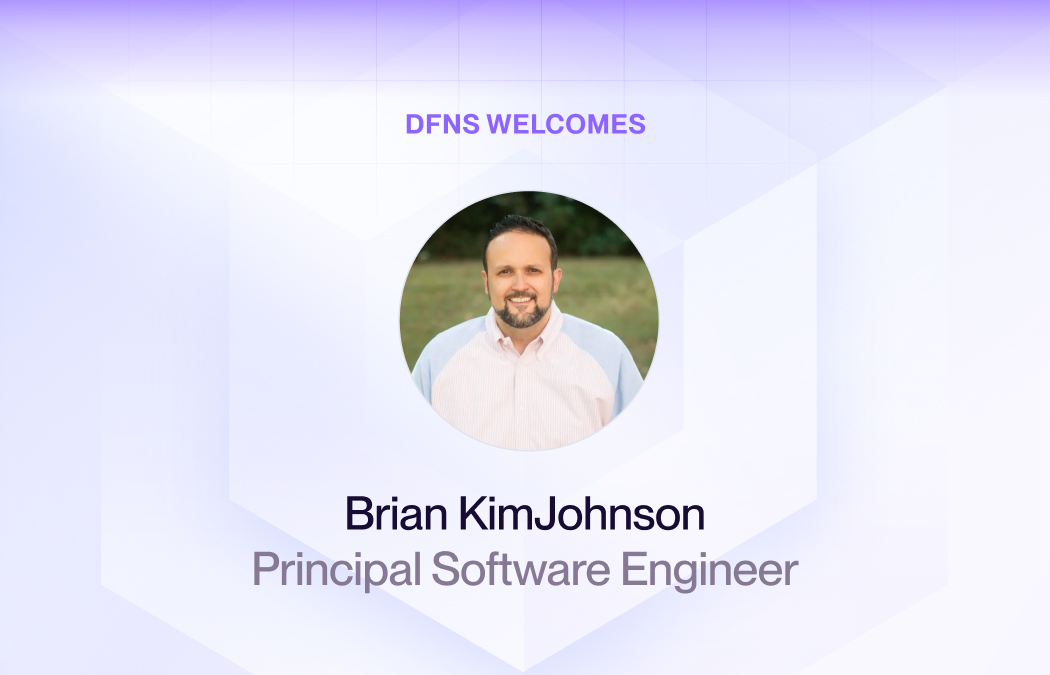
We welcome Brian KimJohnson to Dfns, our newest Principal Software Engineer.
We’re excited to announce that Brian KimJohnson has joined Dfns as a Senior Principal Software Engineer. Brian brings more than 20 years of experience building and operating high-performance systems at scale, across some of the most demanding environments in crypto, fintech and big tech. Throughout his career, he has focused on one thing: turning complex, distributed systems into reliable, secure, production-grade infrastructure that teams and users can trust.
Building wallet infrastructure at scale
Brian spent over eight years at Gemini, where he led Wallet Engineering as VP of Engineering. During that time, he contributed to a fundamental shift in how wallet infrastructure is designed and operated. As Gemini expanded its support for new blockchains, the team faced a growing challenge: how to move from a collection of chain-specific implementations to a unified system capable of supporting a multichain world. Brian was part of the effort that helped consolidate wallet primitives across networks, enabling faster integrations while maintaining strong guarantees around security and correctness. This type of architecture requires handling fundamentally different models, from account-based to UTXO-based chains, as well as managing signing, indexing, and transaction lifecycle across each of them.
At the same time, these systems had to meet institutional-grade expectations. Reliability, compliance, and operational resilience were not optional features but core requirements. Brian worked on systems that were designed to operate under strict regulatory environments while maintaining high availability and performance across all supported assets. The result was infrastructure capable of supporting both rapid growth and increasing complexity without compromising on safety.
Engineering for security and reliability, not just features
In addition to multi-chain wallets at Gemini, Brian focused extensively on core signing systems including tiers based on HSM, Cloud TEEs and MPC solutions. Brian led and delivered Gemini’s multi-cloud MPC solution which maintains low latency signing capability while diversifying counterparty risk. This work emphasized the exactness required by confidential computing designs that support scaled crypto wallet deployments.
Earlier in his career, Brian worked at Amazon and Audible, where he contributed to large-scale distributed systems powering recommendations, personalization, and marketplace experiences. These environments required strict latency guarantees, continuous availability, and the ability to operate at global scale. Working within these constraints helped shape his approach to engineering, where performance and reliability are treated as first-class concerns.
Across each of these roles, a consistent pattern emerges. Brian focuses on building systems that behave predictably under pressure and continue to operate when it matters most.
An engineer’s engineer
Brian is known for his ability to navigate complex technical environments and make them understandable. He has worked across the full stack, from low-level infrastructure to application-layer systems, and has consistently improved engineering practices within the teams he has been part of.
His approach is pragmatic and grounded in real-world constraints. He focuses on clarity in system design, strong operational discipline, and building software that can be maintained and evolved over time. He is equally comfortable diving into deep technical challenges and stepping back to simplify how systems are structured and communicated.
What Brian will build at Dfns
At Dfns, Brian will operate across the full stack of wallet infrastructure, contributing to systems that span from the lowest layers of key management to the highest layers of transaction orchestration. This includes working on hardened signing environments, including air-gapped and offline storage systems, where security boundaries must be strictly enforced while still enabling controlled, auditable operations. These environments require careful coordination between hardware, networking constraints, and software orchestration to ensure that private key material is never exposed while still remaining usable in real-world workflows.
Beyond signing, Brian will contribute to end-to-end data integrity across the platform. This means ensuring that every transaction, from initial construction to final confirmation on-chain, can be authorized, vetted, tracked, and delivered without ambiguity. It involves designing systems that can handle retries, reindexing, and reconciliation across heterogeneous blockchain environments while preserving correctness at every step.
He will also work on blockchain node infrastructure and network interaction layers. Supporting more than 100 blockchains requires managing a diverse set of node implementations, RPC behaviors, and failure modes. Ensuring reliability at this layer is critical to maintaining consistent transaction execution and accurate state across wallets and assets.
Security remains a core focus. Brian will contribute to strengthening the platform’s security model, including isolation boundaries, access control systems, and operational safeguards that prevent misuse while enabling automation. This extends from infrastructure-level protections to application-layer policy enforcement.
Finally, he will help evolve transaction lifecycle management across chains. This includes everything from transaction construction and simulation to policy evaluation, signing, broadcasting, monitoring, and recovery. As systems scale, this lifecycle becomes increasingly complex, especially when handling concurrency, failure scenarios, and cross-chain differences. Building a consistent and reliable abstraction over this complexity is central to Dfns’ value.
We are building infrastructure that financial institutions rely on to move and secure digital assets. This requires a high level of engineering discipline, combining distributed systems, security, and operational rigor. Brian brings exactly that. We’re excited to have him on board.
We’re hiring
Dfns continues to grow across engineering, product, and operations. If you’re interested in building infrastructure for the next generation of financial systems, we’d love to hear from you.
Apply here: jobs.deel.com/job-boards/dfns
Authors

Noah Cornwell
As Chief Technology Officer, Noah heads the engineers team at Dfns. Before joining Dfns, Noah spent over 15 years of his life in technical and engineering leadership roles at crypto exchange and bank Gemini as well as trading firms like MIK Funds and Boston Technologies. He holds an MSc in finance from Northeastern and BSc degree in Economics from the University of Oregon.